



As AI expands the supply of promising technologies, the capacity to establish what works could reshape industrial competition.
A promising material is not yet a reliable battery. A successful cell is not yet a dependable storage system. Between an attractive technical result and a product that customers can use lies a sequence of experiments, manufacturing trials and operating experience. Each stage answers a different question. Progress at one stage does not settle the next.
That sequence deserves more attention as artificial intelligence expands the range of possibilities available to scientists and engineers. The strategic question is how companies will turn a growing supply of possibilities into products whose performance they can understand and stand behind.
McKinsey’s Technology Trends Outlook 2026 identifies AI for scientific discovery and engineering as a newly highlighted trend. Its overview also points to an emerging imbalance: computational advances can generate promising compounds faster than laboratories can synthesize and validate them. Discovery and experimental confirmation do not necessarily accelerate together.
The implication explored here is economic. If the supply of candidates grows faster than the capacity to evaluate them, competitive advantage could move toward organizations that can resolve uncertainty efficiently. The scarce resource would be the ability to establish which ideas deserve further development, under what conditions they work and where they fail.
This is a hypothesis about how value may shift, rather than a prediction that all testing businesses will become more profitable. It depends on the technology, the maturity of the market and how quickly experimental methods themselves improve.
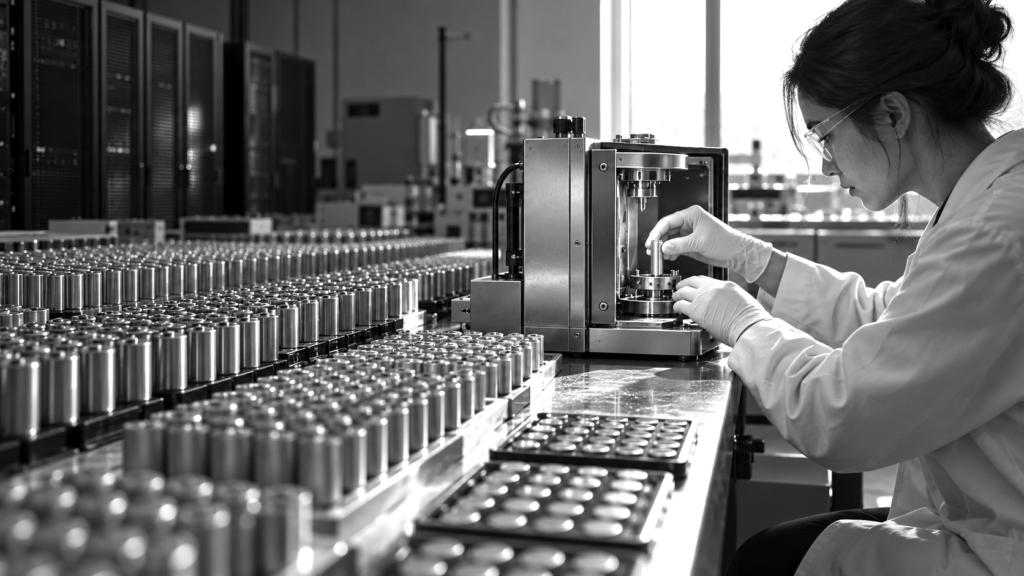
Consider two battery developers. Both have access to powerful modeling tools and generate plausible designs. One can make representative samples, run informative experiments and connect the results to manufacturing decisions. The other must wait for external facilities, has limited access to operating data and struggles to reproduce its best results. Even if their initial discoveries are equally promising, their commercial trajectories could diverge.
The first company can stop weak development paths earlier and commit resources to stronger ones with greater confidence. Its advantage lies partly in the quality and timing of what it learns. A rejected candidate can be a valuable result if rejection happens before an expensive production commitment.
There are several different uncertainties to resolve. A material may be feasible to synthesize but difficult to manufacture consistently. A cell may perform well under one test profile without establishing its suitability for a different application. A product may meet technical expectations while requiring a production process that cannot support competitive economics.
Treating these as one generic question of “technology readiness” hides important distinctions. For a company making investment decisions, the relevant issue is which uncertainty remains between the current result and the next commitment of capital.
Experimental capability therefore has a potential strategic value beyond completing a required test. It can help determine the sequence of investment: when to continue, when to redesign and when to stop. Spending more on discovery while leaving experimental capacity unchanged could produce a longer queue of unresolved possibilities.
Yet the bottleneck is not fixed. AI can improve the physical development process as well as generate candidates. In August 2026, Berkeley Lab reported a modeling approach designed to predict the sequence of solid-state reactions and inform synthesis recipes. Its demonstration concerned barium-titanium oxides; extension to other material classes remained a next step.
The National Laboratory of the Rockies also describes using machine learning to improve battery lifetime modeling, diagnose degradation mechanisms and inform experimental design. These examples matter because they challenge a simple division between fast computation and permanently slow experimentation.
The stronger strategic proposition is that advantage may accrue to companies that connect the two. A model helps choose an experiment; the experiment reveals where the model was wrong; the resulting knowledge improves the next decision. The value comes from the quality of that exchange, including the ability to recognize when a prediction is being applied beyond the conditions that support it.
This could change where companies choose to compete. A developer may need to secure access to pilot manufacturing before expanding its discovery program. An established manufacturer may find that process knowledge and operating experience complement new modeling tools. A testing provider may create value by helping customers design more informative experiments, while preserving the independence needed for its findings to be trusted.
None of these positions guarantees a durable advantage. Shared facilities, open datasets and better automation may broaden access and reduce scarcity. A crowded laboratory can also reflect inefficient scheduling rather than valuable expertise. The important distinction is between charging for a queue and helping customers resolve uncertainty that would otherwise prevent a sound commercial decision.
For investors, this suggests looking at the connection between discovery and experimental learning. The number of promising designs is one signal. The ability to reproduce results, understand failures and translate findings into manufacturing choices is another. A business can have impressive intellectual property and still lack a credible route to resolving the technical questions on which its growth depends.
The corresponding investment opportunity may include capabilities around the technology itself: experimental equipment, pilot production and methods that link physical results with models. Their attractiveness would depend on utilization, customer demand and the usefulness of the uncertainty they resolve. Proximity to an innovation boom is insufficient evidence of a viable business.
For Türkiye, the issue is relevant to the development of batteries, advanced materials and other clean technologies. The useful policy question is whether firms can move between research, representative production and real operating conditions without repeatedly losing access to the facilities or knowledge needed for the next step. This calls for examining connections across the industrial ecosystem, alongside investment in individual facilities.
COP31 provides a setting in which to ask a related question about technology transfer. Access to a design does not by itself establish the ability to adapt it to local materials, production processes and operating conditions. Partnerships that strengthen experimental learning could help recipients develop the knowledge needed to make that technology useful in their own context.
The climate significance lies in the consequences of unresolved uncertainty. An unsuitable technology can absorb capital, require replacement or weaken confidence in a wider transition program. Better experimental learning can help avoid such commitments, although it does not establish environmental benefit on its own. That still depends on how a product is manufactured, deployed and used.As discovery accelerates, industrial strategy needs to account for what happens between possibility and commitment. The companies best placed to benefit may be those that can establish the limits of a result, improve it and carry that knowledge into production. In an economy with more promising ideas, the ability to reach a dependable conclusion could become a more important source of competitive advantage.