
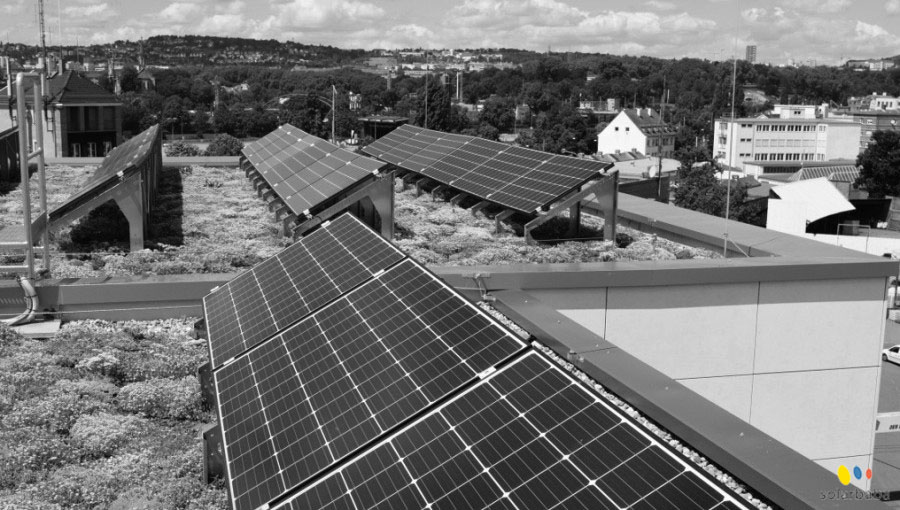
Intensifying heatwaves and severe storms across Europe have made the integration of green roofs with solar panels a vital solution for climate adaptation in buildings. These hybrid systems reduce cooling and overall energy demand while managing stormwater and generating clean, on-site electricity. The Federal Association of Green Buildings (BuGG) in Germany advocates for the systematic greening of roofs and facades to shield urban areas against extreme weather conditions. Vegetation delivers a natural cooling effect that enhances the efficiency of photovoltaic panels while substantially extending the lifespan of roofing insulation.
During heavy downpours, green roofs absorb stormwater to mitigate urban flood risks, while during hot spells, the evaporation of stored water naturally cools the surrounding microclimate. By shielding exterior building envelopes from direct solar radiation, this vegetative layer also maximizes performance when combined with solar arrays. Because the plants lower ambient roof temperatures, the solar panels avoid efficiency losses caused by overheating, generating clean power precisely during peak daytime cooling hours.
The environmental and economic advantages of these systems are well-backed by empirical research. A modeling study conducted by the German Meteorological Service over the city of Essen demonstrated that air temperatures in areas with extensive green roof coverage were approximately 0.7 Kelvin lower than in comparable non-vegetated districts. Another study by the University of Natural Resources and Life Sciences, Vienna (BOKU) revealed that 850 square meters of green facade delivers a cooling and oxygen-generation capacity equivalent to 45 air conditioning units operating eight hours a day.
From a structural perspective, green roofs also extend roof insulation longevity. Evidence indicates that the substrate and plant layers protect waterproofing membranes against ultraviolet degradation, rapid thermal swings, and hail damage. While unprotected flat roofs frequently suffer major deterioration within 16 years, green roof waterproofing can endure for over two decades without requiring extensive repairs. These findings demonstrate that pairing green roofs with solar panels is not merely an eco-friendly choice, but a durable, long-term structural investment.
Source: Solarbaba – In Turkish