

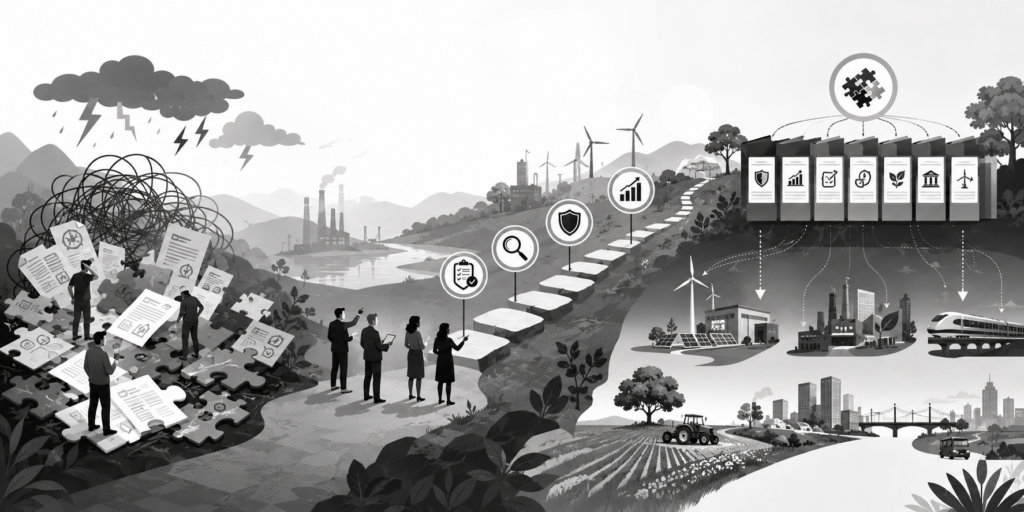
The Core Friction
Transition finance has produced no shortage of innovative transactions. New facilities are launched. New risk-sharing structures are tested. New combinations of public and private capital are assembled. Yet each transaction still seems to require a new design. The project changes, the advisers change, the contracts change, the evidence requirements change, and the financing structure is negotiated again from the beginning. This may be understandable during the early development of a market. It is much harder to defend after years of pilots, facilities, and demonstration projects. Markets do not scale because every transaction is innovative.
They scale when successful transactions become repeatable.
The Cost of Starting Again
Building every deal from scratch creates three recurring problems:
- High Transaction Costs: Each project requires its own legal work, financial analysis, due diligence, and technical assessment. These costs are difficult for smaller projects and businesses to absorb, particularly in emerging markets.
- Slow Decision-Making: When institutions cannot rely on familiar structures, every issue must be reconsidered. Who carries the first loss? What evidence is sufficient? Which risks can be insured? The same questions return in every transaction.
- Limited Learning: Transition finance has generated a large number of pilot projects, but relatively few have become standard models. Lessons remain attached to individual transactions rather than being converted into shared templates that can be used elsewhere.
The result is a market rich in examples, but poor in repetition.
From Transition Pathways to Financing Pathways
The underlying transition is rarely a single event. A steel plant does not become low-carbon through one investment. A textile value chain does not become traceable and resource-efficient through one loan. An agricultural system does not become regenerative after one season. Transition takes place through stages. Technologies are replaced. Operating practices change. Evidence improves. Risks become clearer. Cashflows become more predictable.
Finance should follow the same sequence. Earlier stages may require technical assistance, guarantees, concessional capital, or higher levels of risk absorption. As performance is demonstrated and uncertainty decreases, commercial lenders and institutional investors should be able to enter on more conventional terms. The principle is simple: If the transition pathway can be described, the financing pathway should also become easier to anticipate. That does not mean applying one rigid structure to every sector. Steel, agriculture, energy, transport, and manufacturing have different economics and different risks. But difference does not justify starting from zero. A repeatable financing model should identify:
- Which risks exist at each stage;
- Which party is best placed to carry them;
- What evidence is required before the next stage begins;
- Which type of capital enters at each point; and
- How the structure changes as the asset or business becomes more mature.
This is not standardization for its own sake. It is a way to reduce uncertainty without ignoring sector realities.
The Missing Learning Curve
Other financial markets became scalable because repeated transactions created familiarity. Renewable-energy project finance, mortgages, trade finance and infrastructure lending all rely on established documents, known risk categories, familiar approval processes and predictable financing sequences. Transition finance has not yet developed the same learning curve. The consequences are visible across different parts of the infrastructure market:
- The Preparation Premium: The Global Infrastructure Hub estimates that project-preparation costs in developing countries typically range from 5% to 10% of total project investment, compared with approximately 3% to 5% in developed countries.
- The Dry Powder Overhang: The World Bank reports that private infrastructure funds held approximately $374 billion in uninvested capital in 2023. This does not by itself prove a shortage of financeable projects, but it illustrates that capital availability and deployment are not the same condition.
These figures describe different parts of the market, but they point toward the same structural tension: mobilizing capital, preparing projects and converting unfamiliar structures into investable transactions remain separate challenges. More capital alone will not close that gap. The market also needs repeatable ways to move from project preparation to investment approval.
Beyond the Pilot
Pilots are useful when they test a new idea. They become a problem when the system never moves beyond them. A successful pilot should not end with a case study. It should produce a structure that another institution can understand, adapt, and finance with less time and lower cost.
This is where much of transition finance continues to fall short. We celebrate the transaction, but fail to capture the model. We document the outcome, but not the sequence that made it financeable. We prove that something can work once, but do not make it easier for the next project to follow.
The Core Claim
We do not need to reinvent every transition transaction. We need to standardize the sequence by which capital enters it.
That requires moving from isolated financial structures toward sector-level financing pathways: repeatable models that connect transition stages, evidence requirements, risk ownership, and capital sources. The objective is not to eliminate judgment or project-specific analysis. It is to stop treating every familiar problem as if the market has never encountered it before.
The future of transition finance will not be determined by how many innovative transactions we design. It will be determined by how many of those transactions become repeatable. Markets scale when exceptions become templates.