

In the part 4 of this article series, I examined project shareholder structure including funding options, community engagement with local economic impact, employment opportunities and local supply chain development, public information, environmental safety and acceptance, sustainable urban integration, public information about investment and operational structure after the construction and transportation associations/end users involvement just before analyzing the project management scenarios that will continue in the next series of my article.
Contents (part 4)
7.3 Project Shareholder Structure including Funding options
8. Community Engagement and Local Economic Impact
8.1 Employment Opportunities & Local Supply Chain Development
8.2 Public Information, Environmental Safety and Acceptance
8.3 Sustainable Urban Integration
8.4 Public Information about investment and operational structure after the construction
9. Transportation Associations/End Users
7.3 Project Shareholder Structure including Funding options
7.3.1 A Collaborative Model for Turkish Hydrogen Leadership: Turkiye, Aliaga’s green hydrogen facility exemplifies a next-generation partnership, blending global industrial expertise, municipal leadership, government backing, and international capital. The project’s structure and public outreach position it not just as an energy transition centerpiece for the Turkiye but also as Europe’s and Middle East’s benchmark for cross-border hydrogen investment and deployment.
7.3.2 Ownership and Shareholding: The companies and organizations represent the financial engines and driving forces behind green hydrogen projects, providing the necessary capital and expertise. The core of the project’s ownership will comprise further to the market research and investigations, the project structure is defined for the best interest of the project development and investment, as concluded below.
7.3.3 Energy Companies including Main Electrolyzer Manufacturers and Private Investors: Established particularly Turkish based petrochemical, oil & gas, renewable energy groups, industrial facility contractors/investors, renewable energy firms, end users (as like airway groups transferring to SAP)) and/or the JVs with their international partners; like Tupras, Enerjisa, Ronesans Energy, Enka Energy, Ictas Energy, Akfen Energy, Sanko Energy, Akenergy, Polat Energy, Gama Energy, Hydrogenix, Tekfen, Aksa, THY, Pegasus, Sisecam, Odas Energy etc. and other international key players as part of JVs like with Socar, Shell, Alstom, Technip Energies, Total Energy, Eon, Equinor, Repsol, Enel, Eni, Saipem etc. and main electrolyzer manufacturers (if their electrolysers are used in the project) such as Siemens Energy, ITM Power, McPhy Energy, Thyssenkrupp, Nel, Sunfire and John Cockerill etc., where applicable, that would be the part of the potential shareholders scheme to be involved and taken into account for the partner scheme of project stakeholders holding the shares of this investment. The project partnership structure can be extended maybe by using Chinese partners as the above given partnership scenarios are only the examples.
Energy companies possess substantial experience in developing and managing large-scale energy projects (29) International Energy Agency (IEA), The Future of Hydrogen: Seizing Today’s Opportunities pp. 55-60, June 2019.
Their established infrastructure and market presence provide a crucial platform for integrating hydrogen into existing energy systems (29) They can act as both key investors and/or project developers, leveraging their resources and knowledge to drive project execution. The electrolyzer companies are for the forefront of electrolyzer technology development (30) IRENA, Hydrogen: A Renewable Energy Perspective pp. 35-43, September 2019, that design, manufacture, and supply the electrolysis systems used to produce green hydrogen from renewable energy sources. Advancements in electrolyzer efficiency and scalability are critical for driving down the cost of green hydrogen production.
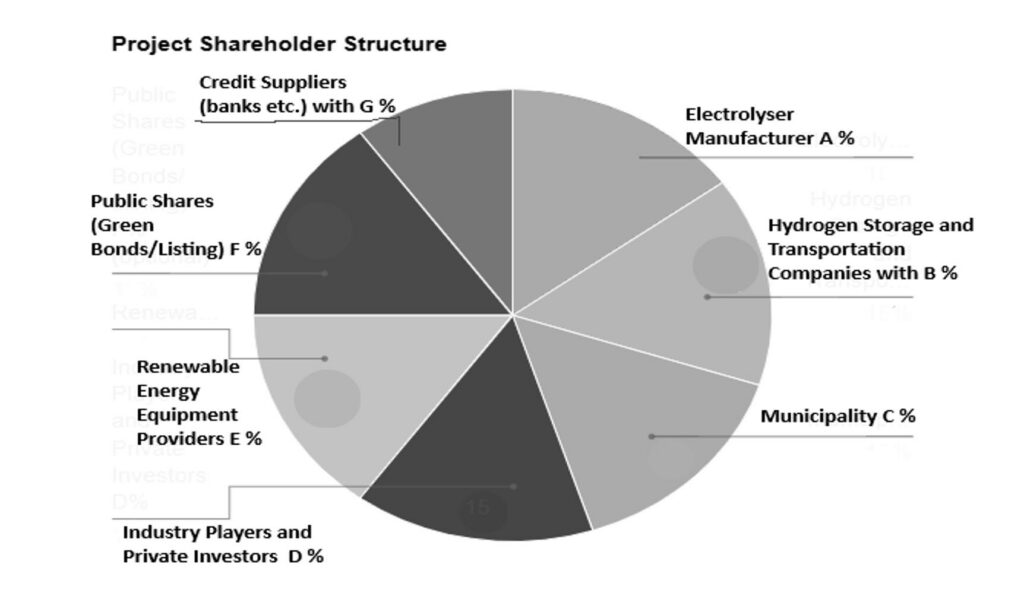
Figure 2: Project Shareholder Structure
7.3.3.1 One of the Electrolyser Manufacturer with A % shares could be selected amongst the other manufacturers as a shareholder, providing turnkey electrolysis technology, full EPC (Engineering, Procurement, and Construction) and Commissioning, and Maintenance, and taking a strategic equity stake. This firm is to be selected further to the evaluations considering the factors such as; their manufacturing base, logistic routes to Aliaga, their global references, proven reliability, and their ability to customize infrastructure solutions for any industrial hubs. Their established infrastructure and market presence shall provide a crucial platform for integrating hydrogen into existing energy systems. They can act as one of the key investors, leveraging their resources and knowledge to drive project execution. Their cooperation shall reinforce efficient project implementation similarly, by means of Shell’s operational knowledge combined with electrolysis technology in the UK.
7.3.3.2 Hydrogen Storage and Transportation Companies with B % shares: Companies like NL Hydrogen, Gasuine Transport Services Netherlands, Linde, and Air Liquide provide the technologies and services required for storing and transporting hydrogen, as an example, one of the storage and transportation company activities are given in this link (31). They shall ensure a reliable and efficient supply of hydrogen to end-users, addressing the logistical challenges associated with its distribution. The development of robust and cost-effective storage and transportation infrastructure is crucial for enabling the widespread adoption of green hydrogen. The Turkish based Borusan etc., and/or any regulated Turkish companies with the JV companies with international companies in storage and transportation should be considered in priority for local economy.
Based on the Aliaga region selection, one of the transport services can be selected with B% shares, amongst the other candidates considering the transportation of the produced green hydrogen by using its existing transport networks and involvement of the national companies in the investment scheme. Their responsibilities shall include monitoring a safe and reliable transport system, operating and developing the gas transport network, providing sufficient transport capacity, maintaining the connection with other networks, both national and international, managing gas quality, balancing the network to ensure that neither too much nor too little gas is being transported. They can collaborate in the operation of hydrogen pipelines outside of the Turkiye to connect any hydrogen pipeline network, after the hydrogen pipelines project concluded in Turkiye in the future expansions.
7.3.3.3 Municipality with C % shares: Considering the selection of Aliaga region for green hydrogen production, it would be the value based co-investor and local facilitator, Aliaga Municipality support is essential for critical aspects such as granting permits, can provide and access to land, land use approvals similar to Freiburg, Germany, where municipal support generates public confidence and social license, and fostering community acceptance. As an example, Rotterdam Municipality vision is provided for a model purpose, in this link (32), and also addressing any concerns of green energy project, infrastructure upgrades, overcoming regulatory complexities and ensuring synergy between city development plans and hydrogen integration in connection with other local authorities.
Turkish Government and National Funds to be granted (refer to above item 6.1.2 (in part 3 of this article)): The governmental initiatives create a conductive environment for investment and innovation, accelerating the deployment of green hydrogen technologies.
International Investment Funds to be granted (refer to above item 6.1.1 (in part 3 of this article)): Dedicated investment funds from European funding sources are to be credited as detailed in the Foundation Sources section 6.1.1 above in this study. Additionally, ongoing communication with other potential funding sources can take place in the meantime, and international support from the World Bank, particularly through the Climate Investment Funds, emphasizes sustainable development in renewable energy, and private funding from the Green Climate Funds can also be considered for this community-based hydrogen production investment (33) BloombergNEF, Hydrogen Economy Outlook, Bloomberg Professional Services, March 30, 2020.
7.3.3.4 Industry Players and Private Investors with D % shares (refer to above item 7.3.3):The value basis (against equipment/system or service supply (as like installation services etc.)) or cash basis investment funds from the dedicated petrochemical, oil & gas, energy groups, investors, renewable energy firms are to be credited as mentioned in the foundation sources section 7.3.3 above in this study if there are any benefits to this project investment structure.
These funds are critical for providing the significant capital investments required for the construction of hydrogen infrastructure projects (23), and can join as minority shareholders, reinforcing the capital base and expanding commercial alliances. Their focus on environmental, social, and governance (ESG) criteria aligns perfectly with the principles of green hydrogen production. Based on the investment agreements of some % shares will be limited and reserved to the one of the selected or amongst the more than one investment funding group above based on their contributions to the funding scheme.
7.3.3.5 Renewable Energy Equipment Providers with E % shares (refer to above item 7.3.3):Suppliers of renewable energy technologies, including some of the manufacturers in section 7.3.3 above provide the wind turbines, solar panels, and other equipment necessary to power the electrolysis process (34) International Energy Agency (IEA). Net Zero by 2050 – A Roadmap for the Global Energy Sector, IEA pp.110-115, October 2021.
The availability of reliable and cost-effective renewable energy sources is fundamental to the economic viability of green hydrogen production (24). They can join as minority shareholders, installing the wind turbines and sun panels in reinforcing wind and solar basis energy production to the electrolyzers, and to take care commissioning, handover and further operational part of wind and sun basis energy production.
7.3.3.6 Project Investment Developer(s) as part of items 7.3.3.4 and/or 7.3.3.5 : Project Originator(s) will take this role with their Strategic Coordination and Development, Permits and Licensing, Financial Structuring, Shareholder Model with Know-How Transfer, Government Relations, Funding Maximization, Project Management, and Risk Management
7.3.3.7 Public Shares (Green Bonds/Listing) with F % shares (optional) or increase shares of others against their investment funds: Optional, future liquidity (back-up plan depending on the financial settlement ), including the public involvement for better understanding of green hydrogen investment for being attractive and local public acceptance, and additionally, a portion of shares could be available through public green bonds or listings, enabling direct investment by residents, pension funds, and sustainability-focused investors to help close the investment gaps, as example, as demonstrated it the figure below. Public shares will help to promote ownership by allowing local investments (35), (36).
7.3.3.8 Credit Suppliers (banks etc.) with G % shares, or increase shares of others against their investment funds: Optional, Vendor financing (back-up plan depending on the financial settlement)
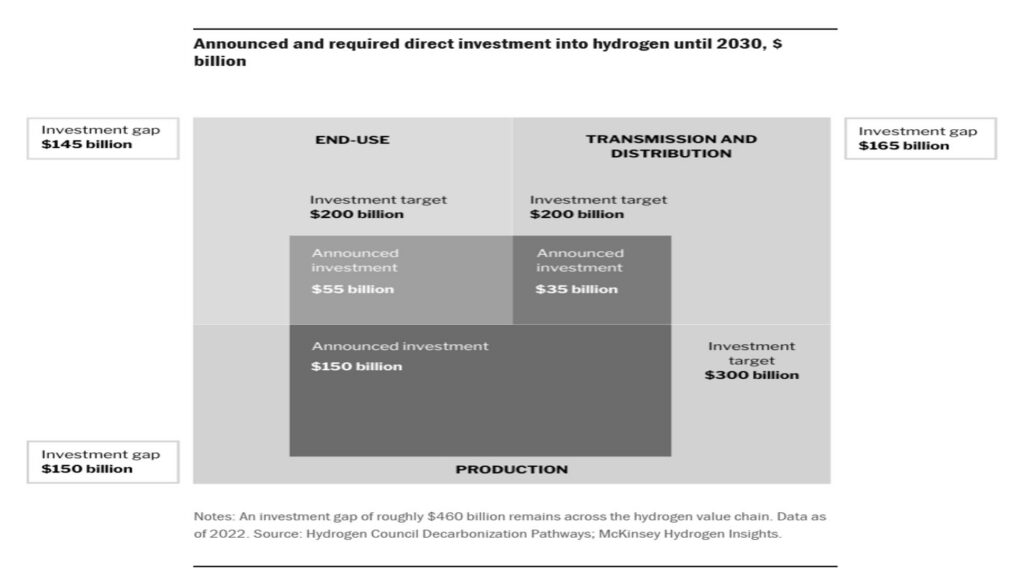
Figure 3: (37)
8. COMMUNITY ENGAGEMENT AND LOCAL ECONOMIC IMPACT
Fostering broad-based community support in Aliaga is at the heart of the project’s social license to operate. The Municipality will drive dialogue with citizens, harbor authorities, and local businesses, focusing on:
8.1 Employment Opportunities & Local Supply Chain Development:
The project will prioritize local hiring and supplier contracts, creating skilled jobs, workforce training, and development opportunities within Aliaga, Izmir and nearby Agean region of Turkiye. Municipal revenues from the facility can fund further urban sustainability programs for local residents in construction, operations, and also engineering roles tied to the hydrogen facility. Prioritizing suppliers from Aliaga, Izmir and nearby Agean region for construction materials, logistics, and maintenance services.
8.2 Public Information, Environmental Safety and Acceptance
Hosting open days, information sessions, and regular project briefings to build public trust explaining green hydrogen is produced using renewable solar and wind power, ensuring zero-carbon energy. Safety protocols and environmental monitoring will be transparent and regularly reported to the community. Hydrogen production will meet the highest Turkish and EU safety standards with strict monitoring and transparency.
8.3 Sustainable Urban Integration
Coordinating with city transport authorities (e.g. transport cooperatives) and industrial users to kick start hydrogen-fueled mobility and industrial decarbonisation initiatives. The facility will be designed to minimize noise, traffic, and visual impact, sited within industrial zones. Community feedback is actively sought through forums and outreach. Through quarterly public meetings, digital newsletters, and a dedicated project website for ongoing updates.
8.4 Public Information about investment and operational structure after the construction
Through public meetings, digital newsletters, and a dedicated project website the updates are to be shared for interest of the public, as like once open, the public can participate through green bonds or designated public share offerings. Once operational, the plant will be managed by a dedicated team, with community oversight through municipality representation. Long term maintenance is to be guaranteed by electrolyzer and other equipment suppliers, securing operational safety and job stability.
Transportation Associations/End Users: These entities represent the demand side of the green hydrogen equation, driving the adoption of hydrogen technologies in various sectors. Public Transportation Authorities: Public transportation authorities, such as municipalities, private bus transport agencies can deploy hydrogen-powered buses, trains, and other public transportation vehicles (38) Fuel Cells and Hydrogen 2 Joint Undertaking, Hydrogen Roadmap Europe: A sustainable pathway for the European Energy Transition, pp. 20-35, Clean Hydrogen Partnership, Luxembourg: Publications Office of the European Union, January 2019. This reduces emissions and stimulates the demand for green hydrogen, showcasing the viability of hydrogen as a clean transportation fuel (38).
Logistics Companies: Logistics companies, including Yurtici Kargo, Aras Kargo, MNG Kargo, DHL Turkiye, TNT Turkiye, UPS Turkiye, PTT Kargo, Surat Kargo etc. (39) can adopt hydrogen-fueled trucks, ships, and forklifts for freight transport (40) World Economic Forum (in collaboration with Boston Consulting Group), Net-Zero Challenge: The supply chain opportunity, pp. 22-28, World Economic Forum, January 2021, in the future plan, if there is sufficient green hydrogen manufacturing capacity in Turkiye. This significantly contributes to the decarbonization of the transportation sector, demonstrating the versatility of hydrogen in addressing diverse logistical needs (40).
Automotive Manufacturers: Automotive manufacturers including the commercial and military vehicle manufacturers in Turkiye, such as Toyota, Fiat, Ford Transit, Hyundai, Mitsubishi, Renault, TOGG, Volkswagen, BMC, Koluman, Nurol etc. (41), are actively developing or going to develop in the short term and deploying fuel cell vehicles. This growing demand for green hydrogen in the transportation sector is driving innovation and investment in hydrogen refueling infrastructure if there is sufficient green hydrogen manufacturing capacity in Turkiye.
Steel Manufacturers: Steel manufacturers, including İskenderun Demir ve Çelik A.Ş., Ereğli Demir ve Çelik Fabrikaları T.A.Ş., İçdaş Çelik Enerji Tersane ve Ulaşım Sanayi A.Ş., Çolakoğlu Metalurji A.Ş., Tosçelik Profil ve Sac Endüstrisi A.Ş., Borçelik Çelik San. Tic. A.Ş., KARDEMİR Karabük Demir Çelik San. ve Tic. A.Ş., Kroman Çelik Sanayii A.Ş., Assan Alüminyum San. ve Tic. A.Ş., Baştuğ Metalurji Sanayi A.Ş., İzmir Demir Çelik Sanayi A.Ş., Borusan Mannesmann Boru San. ve Tic. A.Ş., Kaptan Demir Çelik Endüstrisi ve Ticaret A.Ş., Koç Metalurji A.Ş. etc. (42), https://celik.org.tr/en can utilize green hydrogen in direct reduction processes to reduce their reliance on coal in steel production (43) Material Economics, Industrial Transformation 2050: Pathways to Net-Zero Emissions from EU Heavy Industry, pp.68-98, 2019. This transition to green steel production represents a significant opportunity to decarbonize a traditionally carbon-intensive industry (43).
Chemical Companies: Major chemical companies making production in Turkiye, including BASF, Henkel, Bayer, Evonik, Air Liquide, SOCAR, Linde, Ravago, P&G, PPG, Dow, Sisecam etc. (44) represent potentially significant end-users of green hydrogen (45) Hydrogen Council. Hydrogen Scaling Up, pp. 15-20, Hydrogen Council, November 2017. They can leverage green hydrogen as a feedstock for various chemical processes, thereby reducing their reliance on fossil fuels and mitigating their carbon footprint (45). The integration of green hydrogen into chemical production processes offers a substantial opportunity for decarbonization.
Figure 4: Renewable hydrogen production,distribution,storage,and utilisation value chains
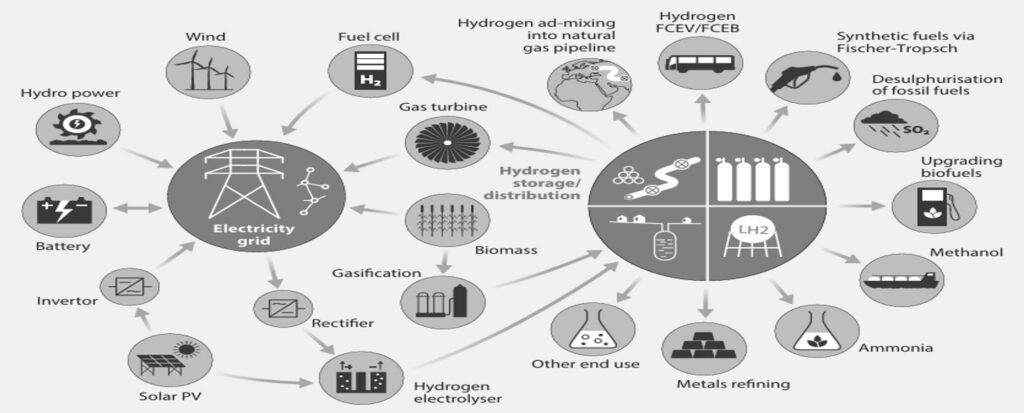
Stephen B Harrison, sbh4 Consulting, (2025), (46) (page 10)
To be continued…