


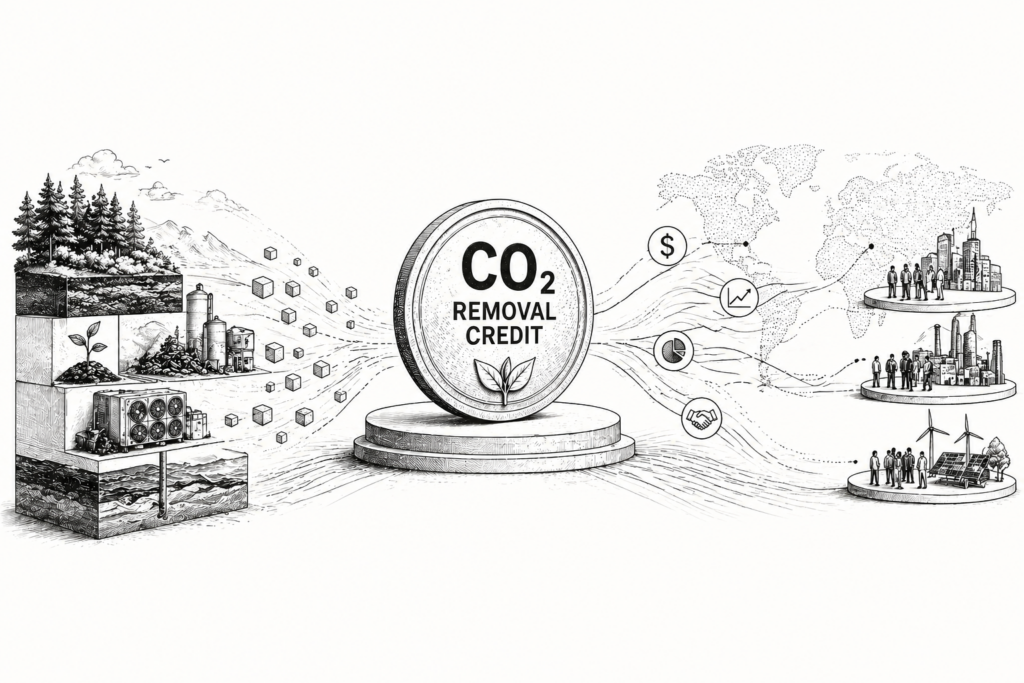
In this CDR Brief issue, we will go deeper into the current situation of CDR credits in the carbon market. Before looking at the market, it is useful to start with the basic unit: the carbon removal credit. A carbon removal credit usually represents one tonne of CO₂ that has been removed from the atmosphere and stored through a defined pathway. For that credit to exist, a project first needs to use an approved methodology that explains how removals are measured, what baseline is used, which emissions are counted, and how storage is monitored. The project is then assessed, monitored, independently verified, and, if the claimed removal is confirmed, credits are issued through a registry. After issuance, the credit can be sold, transferred, and eventually retired by a buyer to support a specific climate claim. This chain from project design to monitoring, verification, issuance, sale, delivery, and retirement is what turns a physical removal activity into a marketable credit. It is also where many of the market’s current challenges appear: supply takes time to build, verification takes time to complete, and buyers often need confidence before large volumes of spot credits are available.
Our focus here is mainly on durable CDR: carbon removal pathways that store CO₂ for long timeframes(200+ years), with lower reversal risk compared to nature-based solutions. This distinction matters because the climate value of a removal depends not only on taking CO₂ out of the atmosphere, but also on keeping it out for a meaningful period. As buyers, standards, and net-zero frameworks become more sophisticated, we expect the market to increasingly move toward durable removals, especially for addressing residual emissions and strengthening the credibility of climate claims.
The Delivery Gap
Carbon removal credits are one of the main ways buyers engage with CDR, yet the market is still defined by early-stage supply, uneven certification pathways, and a wide spread in prices. According to CDR.fyi’s market dashboard, as of 27 April 2026 the market had recorded about $12.0 billion in spending, 47.29 million tonnes sold, and only 1.32 million tonnes delivered, which means roughly 2.8% of sold volume had actually been delivered, which is a significant delivery gap. CDR.fyi also counted 1,063 purchasers, 774 suppliers, and 9,394 orders. That ratio says a great deal about the state of the market: demand exists, but verified spot supply remains limited because many projects are still scaling toward future delivery rather than producing large volumes today.
Standards Shaping the Supply Side
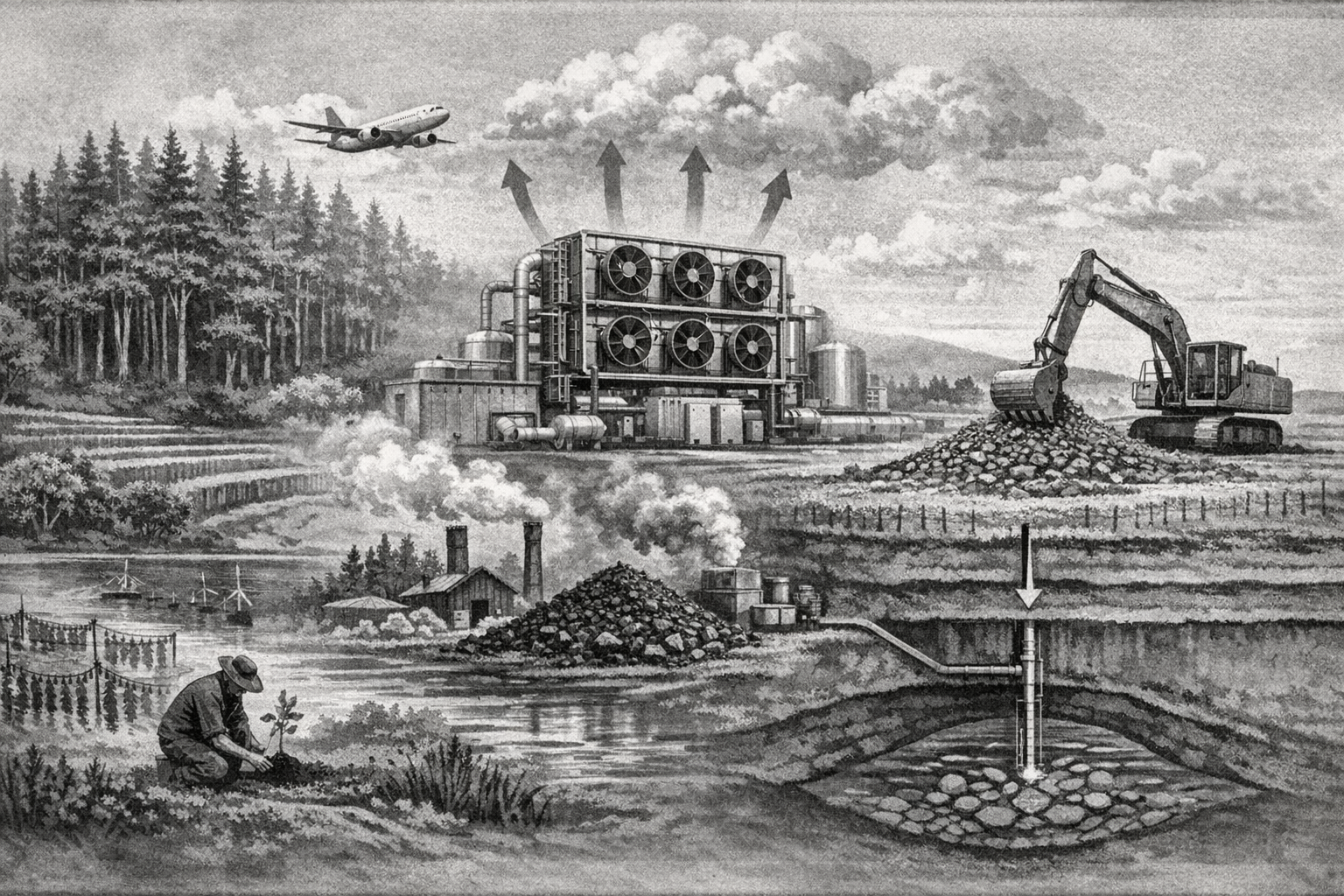
On the supply side, credits can emerge from both nature-based and engineered pathways. Nature-based pathways usually include forests, soils, wetlands, and other ecosystem-based removals. Engineered pathways include biochar, DAC (direct-air-capture), bio-oil sequestration, biomass direct storage, mineralization enhanced rock weathering, and ocean-based removal. Registry coverage is part of the story here. Verra already has an active biochar removals methodology, and Climate Action Reserve has an approved U.S. and Canada Biochar Protocol. Gold Standard has published engineered removals requirements and approved some engineered methodologies, while also opening consultation on its first dedicated biochar carbon removal methodology in April 2026. GCC, for its part, opened consultation on a durable biochar methodology in February 2026. Together, these moves show progress, but they also show that many traditional registries are still expanding into durable CDR step by step rather than covering the category broadly and maturely.
This gap has created space for more specialized carbon removal platforms such as Puro.earth and Isometric. Both have positioned themselves closer to the needs of durable CDR than many traditional registries. Puro.earth and Isometric both play important roles in the durable CDR certification landscape, with different strengths. Puro.earth has been one of the early dedicated platforms for durable carbon removal and has built particularly strong market presence in biochar and other established removal pathways, issuing CO₂ Removal Certificates through its registry. Isometric, meanwhile, has positioned itself around pathway-specific protocols, transparent evidence, and traceability from issuance to retirement, with a strong focus on engineered and scientifically rigorous removals. Together, they show how CDR certification is becoming more specialized as the market moves beyond traditional offset registry models.
Their role is important because engineered removals often require more tailored approaches to measurement, certification, and risk assessment. For now, the market is still waiting for a broader set of actors that can provide the same level of depth across multiple engineered pathways.
Creating Demand Signals
The delivery gap also helps explain why offtakes matter so much. An offtake agreement is a forward purchase arrangement in which a buyer commits to purchasing future carbon removal deliveries from a supplier. In CDR, offtakes are especially important because many projects need demand certainty and financing support before they can scale up and generate large volumes of verified credits. Many project developers can sign forward agreements years before they can produce large quantities of verified spot credits. Frontier, -an advance market commitment- was launched in 2022 to buy permanent carbon removal delivered this decade, with the goal of signaling that at least $1 billion of future revenue could exist for companies that build and deliver. Frontier explains that it aggregates buyer demand and negotiates multi-year purchase agreements, while its prepurchase track supports earlier pilot-stage projects with upfront funding. Frontier has facilitated purchases on behalf of founding members including Stripe, Alphabet, Shopify, Meta, and McKinsey Sustainability, alongside other participating companies. This model matters because it brings future demand forward and helps suppliers finance capacity before spot supply becomes abundant.
Durable CDR’s Pricing Challenge
Pricing reflects that early-stage reality. According to CDR.fyi’s market data, prices vary widely by method. At the high end, direct ocean removal appears around $1,400 per tonne, while biomass direct storage appears around $74 per tonne. That spread is one of the clearest signs that the market is still pricing technology maturity, delivery risk, and measurement complexity very differently across pathways.
“Rock Stars” of Durable CDR
Within that landscape, biochar continues to attract strong demand. Registry activity supports this. Verra’s VM0044, Puro.earth’s biochar methodology, Gold Standard’s new PARC consultation, and Climate Action Reserve’s biochar protocol all point to biochar’s relative practicality and market readiness. CDR.fyi’s supplier leaderboard also shows that many of the top suppliers by both sold and delivered volume are biochar companies, including Exomad Green, Varaha, Carboneers, and Wakefield Biochar. Biochar’s appeal seems to come from a combination of comparatively accessible prices, modular deployment, and a pathway that can deliver verified tonnes earlier than many more capital-intensive methods.
BECCS (bioenergy-with-carbon-capture-and-storage) also remains highly attractive on the demand side, even if it is far harder to deploy. CDR.fyi’s demand structure snapshot shows that Microsoft’s disclosed durable CDR portfolio is concentrated in BECCS, which accounts for about 76% of its contracted volume, or roughly 27.5 million tonnes. That finding reinforces a broader market point: biomass-based pathways, taken together, currently look more commercially advantaged than many tech-intensive pathways because they can combine lower prices, larger theoretical volumes, and clearer routes to durable storage.
Expectations for the Durable CDR Market
Over the last few years, the durable CDR market has developed through a combination of large corporate offtakes, smaller spot purchases, and early-stage market-building initiatives. Microsoft is clearly one of the most influential buyers. According to CDR.fyi, as of 13 April 2026, Microsoft accounted for 36.44 million tonnes, or 78.5% of total disclosed durable CDR tonnes contracted. This shows how strongly one major buyer can shape the forward market.
But the demand picture is broader than Microsoft alone. CDR.fyi also notes that buyers outside Microsoft and Frontier accounted for 90% of delivered tonnes and 94% of retired tonnes to date. In other words, while Microsoft has played an outsized role in long-term contracted volume, actual delivered and retired credits are supported by a wider buyer base. This suggests that demand is becoming more diverse, even if the largest forward commitments remain concentrated among a small number of major actors.
The result is a market with real momentum, but still very selective liquidity. Credits exist across both nature-based and engineered categories, registry infrastructure is improving, and buyer sophistication is growing. Yet the market still leans heavily on forward commitments, biomass-based supply, and a small number of institutions willing to move first. For now, CDR credits are less a mature commodity market than a scaling mechanism for an industry still being built.