
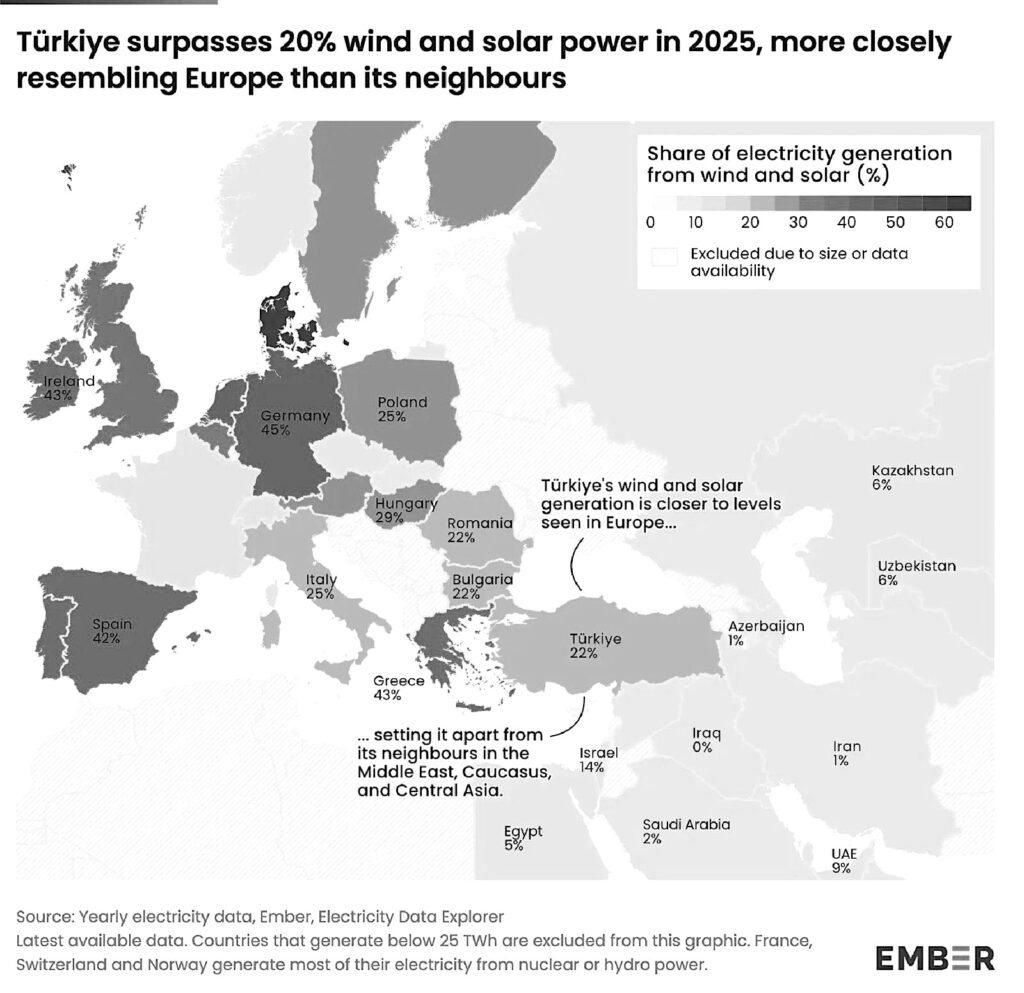
As Türkiye prepares to host COP31 in Antalya, its electricity system reflects a mixed picture: coal remains the largest source of power generation, while wind and solar are expanding rapidly and reaching record shares.
According to Ember’s Türkiye Electricity Review 2026, coal remained Türkiye’s largest source of electricity in 2025, accounting for 34% of generation. Around two-thirds of coal-fired electricity came from imported coal, highlighting the continued role of imported fossil fuels in the power mix. Türkiye added a record 6.5 GW of new wind and solar capacity in 2025, the highest annual combined addition to date.
Solar drove most of the expansion. 2023 marked a turning point for solar deployment with installations jumping to a record 4.8 GW. In 2024 and 2025, solar additions remained elevated at roughly 4.5 GW per year, indicating sustained deployment rather than a one-off spike. This rapid buildout translated directly into generation growth. Solar’s share of electricity generation increased from 4.7% in 2022 to 10.5% in 2025.
Wind accounted for 11.1% of electricity generation in 2025. Combined, wind and solar reached a record 22% of electricity generation in 2025, exceeding one-fifth of total generation for the first time. This marks a notable shift in Türkiye’s power mix. Wind and solar are now a key driver of domestic power generation in the country.
Natural gas remained another major source of generation, particularly in years when hydropower output declined due to drought, often filling the resulting gap. Beyond year-to-year variability, drought has also had a long-term impact on hydropower plants in Türkiye.
Over the past decade, electricity generation from the country’s three largest hydropower plants (Atatürk, Karakaya and Keban) was 29% lower than during 1996-2005, reflecting the long-term impact of drought conditions. In dry years, this causes an average annual increase of $1.8 billion in fossil gas imports. This number rises further when gas prices spike during energy crises. Despite drought conditions, hydropower remains a major source of clean electricity, accounting for an 18% share in generation.
Türkiye still ranks mid-table in Europe on renewable energy. Among Europe’s 24 largest electricity consumers, Türkiye ranks 15th in wind’s share of generation, 14th in solar’s share, and 16th in overall renewable electricity share. On the other hand, Türkiye leads countries across the Middle East, Caucasus and Central Asia in wind and solar share in generation, with no other country in the region surpassing a one-fifth share from these sources.
Battery storage is also emerging as a major growth area. Since 2022, Türkiye approved 33 GW of battery storage projects, more than any single EU country. If realized, this expansion can help integrate larger volumes of wind and solar power into the grid.
Looking ahead, Türkiye has set a target to increase installed wind and solar capacity from roughly 40 GW today to 120 GW by 2035. Meeting that target would require around 8 GW of new wind and solar installations each year, above the record 6.5 GW added in 2025.
Find more details in Ember’s Türkiye Electricity Review 2026: https://ember-energy.org/latest-insights/turkiye-electricity-review-2026/